| Identification |
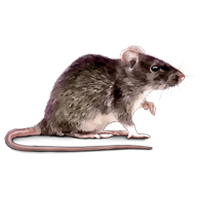
- Gray to a blackish or reddish-brown.
- Stocky and typically with an average size of 16 inches from head to end of tail.
- Average weight ranges from about 9 oz for females and 12 oz for males
|
- Adults weigh between 3 and 12 ounces
- They range in color from light brown to gray and black with a smooth coat
- They have large, thin, hairless ears and a pointed snout
- Rats can fit through openings the size of a dime.
|
| Behavior |
- Are nocturnal, with most of their feeding occurring between sunset and sunrise.
- Typically migrate within 25-100 feet of their nest while foraging.
- Norway rats prefer foods high in carbohydrates or protein but will eat almost anything including non-food items such as soap.
- They prefer to travel along edges, along pipes or rafters, and along overhead utility lines.
- Are generally wary of crossing open spaces that provide no cover. Hedges and other dense vegetation in landscaping or against buildings provide cover for rodent trails.
- Are usually extremely wary of new objects in their environment (Neophobic); however, this is only a temporary hesitation.
- They have amazing physical abilities that allow them to climb vertically in pipes, walk horizontally along wires, and jump from a standstill vertically at least 24 inches and horizontally at least 4 feet. They can also drop from heights of 50 feet without injury.
- All rats can swim. The Norway rat, in particular, is an excellent swimmer, which can swim a half-mile in open water and tread water for up to 3 days. They have also been known to swim up through the water seal of a toilet.
- Rats will gnaw through almost any material with an exposed edge including, wood, chipboard, lead pipes, cinder blocks, aluminum, sheet metal, and glass.
|
- Mainly nocturnal, but can be seen during the day if colonies are overpopulated.
- Roof rats keep a territory of about 100 to 300 feet.
- Roof rats prefer fresh plant material such as fruits, vegetables, nuts, seeds and tree bark. They are frequently associated with avocado and citrus trees. Roof rats will also eat insects, slugs, and snails.
- They prefer to travel along edges, along pipes or rafters, and along overhead utility lines.
- Are generally wary of crossing open spaces that provide no cover. Hedges and other dense vegetation in landscaping or against buildings provide cover for rodent trails.
- Are usually extremely wary of new objects in their environment (Neophobic); however, this is only a temporary hesitation.
- They have amazing physical abilities that allow them to climb vertically in pipes, walk horizontally along wires, and jump from a standstill vertically at least 24 inches and horizontally at least 4 feet. They can also drop from heights of 50 feet without injury.
- All rats can swim.
- Rats will gnaw through almost any material with an exposed edge including, wood, chipboard, lead pipes, cinder blocks, aluminum, sheet metal, and glass.
|
| Habitat |
- Will nest in basements and lower parts of buildings.
- Burrow in soil and can gnaw through wood, lead, aluminum, copper, cinder block and unsecured concrete.
- Burrows can be found near foundations and under vegetation.
- Nests are often lined with fibrous material like shredded cloth or paper.
|
- Roof rats nest in vegetation like trees or ivy and in structures, typically the upper portions of buildings.
- In buildings, they are typically found in wall voids and false ceilings.
- In the absence of vegetation, they will burrow in the ground.
- Nests are typically round and filled with shredded materials, vegetation or cloth.
|
|
Life Cycle
|
- Become sexually mature at 3-5 .months old and females go into heat every 4-5 days.
- The gestation period is 21 days, after which females birth typically a dozen young.
- Females can produce 4-7 litters per year.
- Adults usually live 9-12 months.
|
- Adults are polyestrous (multiple breeding cycles)
- The average litter size is between 5 and 12.
- They can have up to 9 liters per year depending on food availability. Roof rats have an average of 5 litters per year.
- The gestation period is 20-25 days.
- Lifespan is generally under 1 year.
|
|
Seasonality
|
- Breeds year-round with peaks in spring and fall
|
- In subtropical climates, rats can reproduce year-round.
- In cooler climates populations peak in spring and fall.
|
|
Favorable Conditions
|
- Poor sanitation provides rats with ample quantities of food to sustain large numbers of rats.
- Improperly stored food and waste allow another food resource for rat populations to flourish. Pet foods are a common meal for rats and should be stored properly as well.
- Clutter and improper storage practices provide abundant hiding places, nesting sites, and travel routes for rats.
- Dense vegetation and ground cover can act as excellent nests and rat highways.
|
- Poor sanitation provides rats with ample quantities of food to sustain large numbers of rats.
- Improperly stored food and waste allow another food resource for rat populations to flourish. Pet foods are a common meal for rats and should be stored properly as well.
- Clutter and improper storage practices provide abundant hiding places, nesting sites, and travel routes for rats.
- Dense vegetation and ground cover can act as excellent nests and rat highways.
|
|
Health Concerns
|
- Contaminate food and eating utensils
- Can transfer diseases bite, from vectors like fleas or mites on the rat, or contamination from feces, or urine.
|
- Contaminate food and eating utensils
- Can transfer diseases bite, from vectors like fleas or mites on the rat, or contamination from feces, or urine.
|
|
Signs of an infestation
|
- Sightings of live or dead rodents
- Droppings, urine stains, and rub marks
- Nesting material such as paper or cloth.
- Burrows leading to the structure or in an open space next to the structure.
- Gnaw marks on doors, electrical wires, or trash bins.
- Biting pest symptoms from ectoparasites
|
- Sightings of live or dead rodents
- Droppings, urine stains, and rub marks
- Gnaw marks on wires, food packages, wood and other parts of the structure
- Nesting material like paper, cotton, or other fabrics
- Biting pest symptoms from ectoparasites
|